Buy leitern.eu ?
We are moving the project
leitern.eu .
Are you interested in purchasing the domain
leitern.eu ?
domain@kv-gmbh.de · 0541-91531010
Buy leitern.eu ?
What are the 5 steps to developing a chemical equation?
The five steps to developing a chemical equation are: 1. Identify the reactants and products involved in the chemical reaction. 2. Write the chemical formulas for the reactants on the left side of the equation and the products on the right side. 3. Balance the equation by ensuring that the number of atoms of each element is the same on both sides. 4. Include the physical states of the reactants and products (solid, liquid, gas, or aqueous). 5. Check to make sure the equation follows the law of conservation of mass, where the total mass of the reactants equals the total mass of the products. **
How do I solve this equation with the calculation steps?
To solve an equation, you need to isolate the variable on one side of the equation. Start by simplifying both sides of the equation by combining like terms. Then, use inverse operations to move terms to the other side of the equation. Continue this process until the variable is isolated on one side and you have found its value. Remember to perform the same operation on both sides of the equation to maintain equality. **

Similar search terms for Equation
Top-Angebote
Products related to Equation:
-
Uplift Picks Wall Mounted Cat Climbing Shelves With Hammock Steps And Wooden Jumping Platforms segmented LadderGive your cat a higher place to climb, rest, and watch the room like it is their own little kingdom. These cat climbing shelves create a wall mounted play zone with steps, platforms, and a hammock for lounging. The wall mounted cat hammock design...147,98 $*Shipping: 0,00 $Secure redirect to the provider
-
Uplift Picks Wall Mounted Cat Climbing Shelves With Hammock Steps And Wooden Jumping Platforms jump PlatformGive your cat a higher place to climb, rest, and watch the room like it is their own little kingdom. These cat climbing shelves create a wall mounted play zone with steps, platforms, and a hammock for lounging. The wall mounted cat hammock design...102,98 $*Shipping: 0,00 $Secure redirect to the provider
-
Uplift Picks Wall Mounted Cat Climbing Shelves With Hammock Steps And Wooden Jumping Platforms cat Face CGive your cat a higher place to climb, rest, and watch the room like it is their own little kingdom. These cat climbing shelves create a wall mounted play zone with steps, platforms, and a hammock for lounging. The wall mounted cat hammock design...159,98 $*Shipping: 0,00 $Secure redirect to the provider
-
Uplift Picks Wall Mounted Cat Climbing Shelves With Hammock Steps And Wooden Jumping Platforms cat Face AGive your cat a higher place to climb, rest, and watch the room like it is their own little kingdom. These cat climbing shelves create a wall mounted play zone with steps, platforms, and a hammock for lounging. The wall mounted cat hammock design...132,98 $*Shipping: 0,00 $Secure redirect to the provider



-
What is the mesh equation and the node equation?
The mesh equation is a fundamental equation used in circuit analysis to calculate the current flowing in a loop of a circuit. It is based on Kirchhoff's voltage law and states that the sum of the voltage drops around a closed loop in a circuit is equal to the product of the current flowing in the loop and the total resistance of the loop. The node equation, on the other hand, is used to calculate the voltage at a specific node in a circuit. It is based on Kirchhoff's current law and states that the sum of currents entering a node is equal to the sum of currents leaving the node. This equation is used to solve for the voltage at a particular node in a circuit. **
-
'Equation and what?'
Equation and inequality are two fundamental concepts in mathematics. An equation is a statement that two expressions are equal, while an inequality is a statement that two expressions are not equal. Equations are used to find the value of a variable that makes the equation true, while inequalities are used to compare two quantities. Both equations and inequalities are essential tools in solving mathematical problems and modeling real-world situations. **
-
How can one reduce this equation to a quadratic equation?
To reduce an equation to a quadratic equation, one can use the method of substitution. By substituting a variable for a certain expression in the equation, one can transform the equation into a quadratic form. Another method is completing the square, which involves rearranging the equation to isolate the quadratic term and then adding or subtracting a constant to complete the square. Additionally, one can use the quadratic formula to solve for the roots of the equation, which can help in reducing the equation to a quadratic form. **
-
Is a linear equation the same as a parameter equation?
No, a linear equation and a parameter equation are not the same. A linear equation is an equation of the form y = mx + b, where m and b are constants and x and y are variables. A parameter equation, on the other hand, is an equation that contains parameters, which are variables that represent certain values in the equation. Parameter equations can be linear or non-linear, but the presence of parameters distinguishes them from regular linear equations. **

How can one convert a coordinate equation into a normal equation?
To convert a coordinate equation into a normal equation, you can start by rearranging the equation to isolate the dependent variable on one side. Then, you can simplify the equation by combining like terms and performing any necessary operations. Finally, you can rewrite the equation in standard form, which typically involves expressing the equation in terms of y = mx + b, where m is the slope and b is the y-intercept. **
What is the second-order difference equation for an inhomogeneous equation?
The second-order difference equation for an inhomogeneous equation is of the form \(y[n] - a_1y[n-1] - a_2y[n-2] = x[n]\), where \(y[n]\) represents the output sequence, \(x[n]\) represents the input sequence, and \(a_1\) and \(a_2\) are constants. This equation describes how the current output value \(y[n]\) is related to the previous two output values \(y[n-1]\) and \(y[n-2]\), as well as the current input value \(x[n]\). The inhomogeneous term \(x[n]\) represents any external influences or disturbances acting on the system. **
Top-Angebote
Products related to Equation:
-
Uplift Picks Wall Mounted Cat Climbing Shelves With Hammock Steps And Wooden Jumping Platforms cat HammockGive your cat a higher place to climb, rest, and watch the room like it is their own little kingdom. These cat climbing shelves create a wall mounted play zone with steps, platforms, and a hammock for lounging. The wall mounted cat hammock design...172,98 $*Shipping: 0,00 $Secure redirect to the provider
-
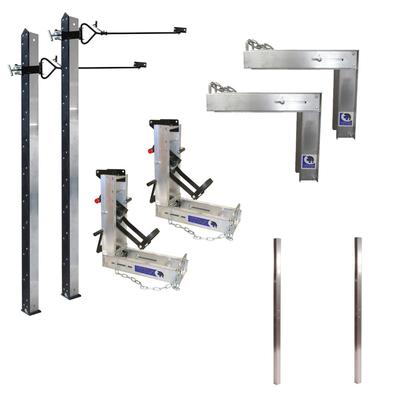
Titan 24 Foot Scaffolding Pump Jack KitThe Titan 24 Foot Pump Jack Kit is a comprehensive solution for professionals in construction painting or roofing who need a reliable OSHA-compliant scaffolding system. Designed for convenience and performance this all-in-one pump jack scaffolding...1749,99 $*Shipping: 0,00 $Secure redirect to the provider
-
Uplift Picks Wall Mounted Cat Climbing Shelves With Hammock Steps And Wooden Jumping Platforms segmented LadderGive your cat a higher place to climb, rest, and watch the room like it is their own little kingdom. These cat climbing shelves create a wall mounted play zone with steps, platforms, and a hammock for lounging. The wall mounted cat hammock design...147,98 $*Shipping: 0,00 $Secure redirect to the provider
-
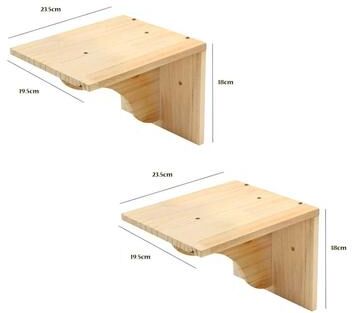
Uplift Picks Wall Mounted Cat Climbing Shelves With Hammock Steps And Wooden Jumping Platforms jump PlatformGive your cat a higher place to climb, rest, and watch the room like it is their own little kingdom. These cat climbing shelves create a wall mounted play zone with steps, platforms, and a hammock for lounging. The wall mounted cat hammock design...102,98 $*Shipping: 0,00 $Secure redirect to the provider
-
What are the 5 steps to developing a chemical equation?
The five steps to developing a chemical equation are: 1. Identify the reactants and products involved in the chemical reaction. 2. Write the chemical formulas for the reactants on the left side of the equation and the products on the right side. 3. Balance the equation by ensuring that the number of atoms of each element is the same on both sides. 4. Include the physical states of the reactants and products (solid, liquid, gas, or aqueous). 5. Check to make sure the equation follows the law of conservation of mass, where the total mass of the reactants equals the total mass of the products. **
-
How do I solve this equation with the calculation steps?
To solve an equation, you need to isolate the variable on one side of the equation. Start by simplifying both sides of the equation by combining like terms. Then, use inverse operations to move terms to the other side of the equation. Continue this process until the variable is isolated on one side and you have found its value. Remember to perform the same operation on both sides of the equation to maintain equality. **
-
What is the mesh equation and the node equation?
The mesh equation is a fundamental equation used in circuit analysis to calculate the current flowing in a loop of a circuit. It is based on Kirchhoff's voltage law and states that the sum of the voltage drops around a closed loop in a circuit is equal to the product of the current flowing in the loop and the total resistance of the loop. The node equation, on the other hand, is used to calculate the voltage at a specific node in a circuit. It is based on Kirchhoff's current law and states that the sum of currents entering a node is equal to the sum of currents leaving the node. This equation is used to solve for the voltage at a particular node in a circuit. **
-
'Equation and what?'
Equation and inequality are two fundamental concepts in mathematics. An equation is a statement that two expressions are equal, while an inequality is a statement that two expressions are not equal. Equations are used to find the value of a variable that makes the equation true, while inequalities are used to compare two quantities. Both equations and inequalities are essential tools in solving mathematical problems and modeling real-world situations. **
Similar search terms for Equation
-
Uplift Picks Wall Mounted Cat Climbing Shelves With Hammock Steps And Wooden Jumping Platforms cat Face CGive your cat a higher place to climb, rest, and watch the room like it is their own little kingdom. These cat climbing shelves create a wall mounted play zone with steps, platforms, and a hammock for lounging. The wall mounted cat hammock design...159,98 $*Shipping: 0,00 $Secure redirect to the provider
-
Uplift Picks Wall Mounted Cat Climbing Shelves With Hammock Steps And Wooden Jumping Platforms cat Face AGive your cat a higher place to climb, rest, and watch the room like it is their own little kingdom. These cat climbing shelves create a wall mounted play zone with steps, platforms, and a hammock for lounging. The wall mounted cat hammock design...132,98 $*Shipping: 0,00 $Secure redirect to the provider
-
Uplift Picks Wall Mounted Cat Climbing Shelves With Hammock Steps And Wooden Jumping Platforms cat Face BGive your cat a higher place to climb, rest, and watch the room like it is their own little kingdom. These cat climbing shelves create a wall mounted play zone with steps, platforms, and a hammock for lounging. The wall mounted cat hammock design...157,98 $*Shipping: 0,00 $Secure redirect to the provider
-
Uplift Picks Wall Mounted Cat Climbing Shelves With Hammock Steps And Wooden Jumping Platforms jump Platform (2 Pcs)Give your cat a higher place to climb, rest, and watch the room like it is their own little kingdom. These cat climbing shelves create a wall mounted play zone with steps, platforms, and a hammock for lounging. The wall mounted cat hammock design...197,98 $*Shipping: 0,00 $Secure redirect to the provider
-
How can one reduce this equation to a quadratic equation?
To reduce an equation to a quadratic equation, one can use the method of substitution. By substituting a variable for a certain expression in the equation, one can transform the equation into a quadratic form. Another method is completing the square, which involves rearranging the equation to isolate the quadratic term and then adding or subtracting a constant to complete the square. Additionally, one can use the quadratic formula to solve for the roots of the equation, which can help in reducing the equation to a quadratic form. **
-
Is a linear equation the same as a parameter equation?
No, a linear equation and a parameter equation are not the same. A linear equation is an equation of the form y = mx + b, where m and b are constants and x and y are variables. A parameter equation, on the other hand, is an equation that contains parameters, which are variables that represent certain values in the equation. Parameter equations can be linear or non-linear, but the presence of parameters distinguishes them from regular linear equations. **
-
How can one convert a coordinate equation into a normal equation?
To convert a coordinate equation into a normal equation, you can start by rearranging the equation to isolate the dependent variable on one side. Then, you can simplify the equation by combining like terms and performing any necessary operations. Finally, you can rewrite the equation in standard form, which typically involves expressing the equation in terms of y = mx + b, where m is the slope and b is the y-intercept. **
-
What is the second-order difference equation for an inhomogeneous equation?
The second-order difference equation for an inhomogeneous equation is of the form \(y[n] - a_1y[n-1] - a_2y[n-2] = x[n]\), where \(y[n]\) represents the output sequence, \(x[n]\) represents the input sequence, and \(a_1\) and \(a_2\) are constants. This equation describes how the current output value \(y[n]\) is related to the previous two output values \(y[n-1]\) and \(y[n-2]\), as well as the current input value \(x[n]\). The inhomogeneous term \(x[n]\) represents any external influences or disturbances acting on the system. **
* All prices are inclusive of VAT and, if applicable, plus shipping costs. The offer information is based on the details provided by the respective shop and is updated through automated processes. Real-time updates do not occur, so deviations can occur in individual cases. ** Note: Parts of this content were created by AI.