Buy leitern.eu ?
We are moving the project
leitern.eu .
Are you interested in purchasing the domain
leitern.eu ?
domain@kv-gmbh.de · 0541-91531010
Buy leitern.eu ?
What is a USB port?
A USB port, or Universal Serial Bus port, is a standard interface used to connect various devices to a computer. It allows for the transfer of data and power between the computer and the connected device. USB ports are commonly found on computers, laptops, and other electronic devices, and they come in different shapes and sizes, such as USB-A, USB-B, and USB-C. These ports are widely used for connecting devices such as external hard drives, keyboards, mice, printers, and smartphones to a computer. **
How can I connect an old USB port to a regular USB port?
You can connect an old USB port to a regular USB port by using an adapter or a converter. There are various types of adapters available, such as USB-A to USB-C or USB-A to micro-USB, which can help you connect older USB devices to newer USB ports. Additionally, you can use a USB hub, which allows you to connect multiple USB devices to a single USB port on your computer. These solutions can help you bridge the gap between old and new USB ports and ensure compatibility with your devices. **


Similar search terms for Lindy-USB-A-Port-Blocker
Top-Angebote
Products related to Lindy-USB-A-Port-Blocker:
-
Lindy RJ45 Port Blocker Key, GreenWith the Lindy RJ-45 Port Blocker Key, the user can quickly block open network ports and easily prevent users from connecting cables, devices or inserting foreign objects without permission.This helps protect against unauthorised access to a network or system, as well as preventing unintentional or malicious damage to ports. It can also act as a visual cue, showing inactive or disconnected ports, ideal for use in schools, office or other public sector environments.The semi-permanent RJ-45 Port Blocker is made up of a moulded plastic blocking cap that plugs securely into the RJ-45 port with a special insertion key. The blocker latches into the RJ-45 just as a network cable would and remains in place until removed using the insertion key.To use, simply attach a blocker to the key and plug it into the port. Hold the blocker in place and pull away the Key. To remove simply insert the Key back into the blocker until it 'clicks' and pull it away.Security Note: The Port Blockers will only act as a basic physical and visual deterrent to tampering. It will not prevent a determined attacker, intent on gaining physical access to a RJ-45 port.Please note: this key is only compatible with the corresponding colour of port blocker.10,99 £*Shipping: 0,00 £Secure redirect to the provider
-
Lindy USB-C Port Blocker Extra Lock Pack (10x Locks, No Key) - PinkRefill pack of 10 pink USB-C port blocker locks from Lindy (part no. 40437). The locks plug into USB-C ports to physically stop unauthorised users connecting pen drives, storage or mobile devices to shared workstations and public-facing equipment.No key is included: the locks are inserted and removed with a Lindy pink USB-C port blocker key, sold separately. The locks only work with the key of the matching colour.36,49 £*Shipping: 0,00 £Secure redirect to the provider
-
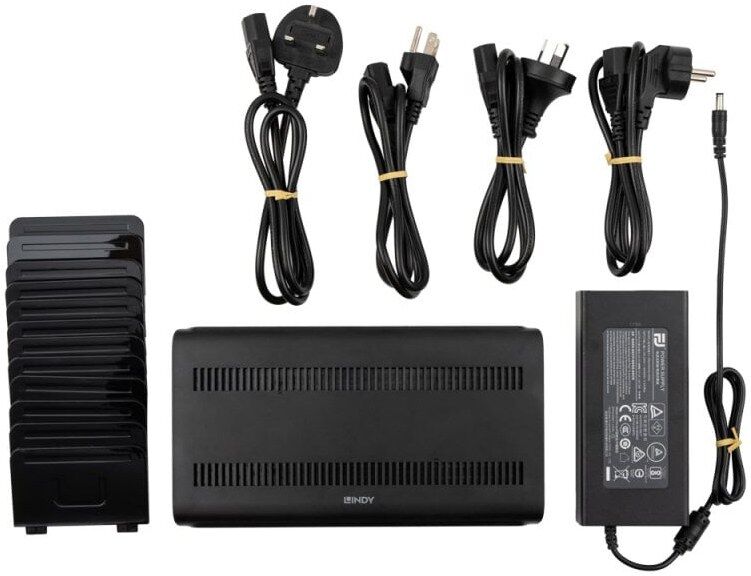
Lindy 240W 10 Port USB Charging StationThe Lindy 240W 10 Port USB Charging Station allows charging up to 2 USB devices via Type A and 8 via Type C like tablets, smartphones or a laptop or Macbook. Each USB Type A port can provide up to 5V 2.4A, eight USB Type C ports can provide up to 30W, 45W or 100W each to satisfy the most power hungry devices. The two Type C ports which can support 100W each support 65W and 35W if shared. The two Type C ports which can support 45W each support 25W and 20W when shared. If all 10 ports are occupied and/or when total power draw is higher than 270W, 73447 will enter protection mode.With its smart charging function and support of many different protocols like BC 1.2, Apple 5V 2.4A, QC5, QC3+, FCP, SCP, AFC and SFCP, this USB Charging Station can recognise the connected device to automatically adjust the charging current for a fast and safe charge.USB Power Delivery Revision 3.0 enables higher power to applications up to 100W, including larger notebooks, gaming PCs, Macbooks, workstations or Docking Stations. Additional Type C PD 3.0 ports with up to 30W and 45W each allow fast, flexible and safe charge of smartphones and tablets.This USB Charging Station also provides overcurrent and short-circuit protection to avoid excessive current damaging the device.Plastic dividers can be assembled and stood on the top of the unit, which allows different widths for different tablets or mobile phone sizes. This product is perfect for use in schools, libraries, hotels, restaurants or any location that uses multiple devices. Country specific power cables are provided for seamless use of the charging station, ideal for global events or integration into installations abroad.158,99 £*Shipping: 0,00 £Secure redirect to the provider


-
Which tablets have an HDMI port, a USB port, and a keyboard?
Some tablets that have an HDMI port, a USB port, and a keyboard include the Microsoft Surface Pro series, the Lenovo Yoga Tab series, and the Samsung Galaxy Tab S series. These tablets are designed to provide a more laptop-like experience with the ability to connect to external displays and peripherals through HDMI and USB ports, and they also come with detachable or attachable keyboards for added productivity. These features make them suitable for users who need a versatile and portable device for work or entertainment. **
-
Can I use my motherboard with a USB 3.1 port for a case with a USB 3.0 port?
Yes, you can use a motherboard with a USB 3.1 port for a case with a USB 3.0 port. The USB 3.1 port is backwards compatible with USB 3.0, so you can connect the case's USB 3.0 port to the motherboard's USB 3.1 port without any issues. The USB 3.0 port on the case will operate at its maximum speed when connected to the USB 3.1 port on the motherboard. **
-
How can I retrofit a USB port?
To retrofit a USB port, you will need to first identify a suitable location on the device where you want to install the port. Next, you will need to carefully open up the device and locate the internal circuitry where you can connect the USB port. You will then need to solder the USB port onto the circuit board, making sure to connect the correct pins. Finally, you will need to secure the USB port in place and reassemble the device. It is recommended to have some experience with electronics and soldering before attempting this retrofit. **
-
How do I connect a USB port?
To connect a USB port, you will need a USB cable that is compatible with the device you want to connect. Simply plug one end of the USB cable into the USB port on your device, and the other end into the USB port on your computer or power adapter. Make sure the connection is secure and then your device should be recognized by your computer or start charging if connected to a power adapter. If you are connecting a USB device, such as a printer or external hard drive, you will also need to install any necessary drivers or software for the device to work properly. **


Is a lamp with a USB port harmful?
A lamp with a USB port is not inherently harmful. The USB port is typically used for charging devices like phones or tablets, which can be convenient. However, as with any electrical device, it is important to use the lamp properly and follow safety guidelines to prevent any potential hazards such as electrical shocks or fires. It is recommended to use the lamp according to the manufacturer's instructions and avoid overloading the USB port with too many devices. **
Can you connect a television with a USB port to USB 3.0?
Yes, you can connect a television with a USB port to a USB 3.0 port. USB 3.0 is backward compatible, meaning it can work with devices that have USB 2.0 or USB 1.1 ports. However, the transfer speed will be limited to the capabilities of the television's USB port. So, while you can physically connect the two, the speed at which data is transferred may be limited by the television's USB port. **
Top-Angebote
Products related to Lindy-USB-A-Port-Blocker:
-
Lindy USB-A Port Blocker Kit (4x Locks + 1x Key) - PinkLindy USB-A port blocker kit in pink (part no. 40450): four USB Type-A port blockers and one removal key. Each blocker clicks into a USB-A port to stop USB drives, phones and other devices being plugged in, helping to prevent data theft, malware introduced by removable media, and dust or tampering damage. No tools or software are needed.Blockers and keys are colour-coded: the pink key only removes pink blockers, so different colours can be used for different areas or access levels. Spare keys and 10-packs of extra blockers are sold separately.Contents: 4x USB-A port blockers, 1x keyConnector: USB Type-AWarranty: 2 years (Lindy)32,49 £*Shipping: 0,00 £Secure redirect to the provider
-
Lindy RJ45 Port Blocker Key, GreenWith the Lindy RJ-45 Port Blocker Key, the user can quickly block open network ports and easily prevent users from connecting cables, devices or inserting foreign objects without permission.This helps protect against unauthorised access to a network or system, as well as preventing unintentional or malicious damage to ports. It can also act as a visual cue, showing inactive or disconnected ports, ideal for use in schools, office or other public sector environments.The semi-permanent RJ-45 Port Blocker is made up of a moulded plastic blocking cap that plugs securely into the RJ-45 port with a special insertion key. The blocker latches into the RJ-45 just as a network cable would and remains in place until removed using the insertion key.To use, simply attach a blocker to the key and plug it into the port. Hold the blocker in place and pull away the Key. To remove simply insert the Key back into the blocker until it 'clicks' and pull it away.Security Note: The Port Blockers will only act as a basic physical and visual deterrent to tampering. It will not prevent a determined attacker, intent on gaining physical access to a RJ-45 port.Please note: this key is only compatible with the corresponding colour of port blocker.10,99 £*Shipping: 0,00 £Secure redirect to the provider
-
What is a USB port?
A USB port, or Universal Serial Bus port, is a standard interface used to connect various devices to a computer. It allows for the transfer of data and power between the computer and the connected device. USB ports are commonly found on computers, laptops, and other electronic devices, and they come in different shapes and sizes, such as USB-A, USB-B, and USB-C. These ports are widely used for connecting devices such as external hard drives, keyboards, mice, printers, and smartphones to a computer. **
-
How can I connect an old USB port to a regular USB port?
You can connect an old USB port to a regular USB port by using an adapter or a converter. There are various types of adapters available, such as USB-A to USB-C or USB-A to micro-USB, which can help you connect older USB devices to newer USB ports. Additionally, you can use a USB hub, which allows you to connect multiple USB devices to a single USB port on your computer. These solutions can help you bridge the gap between old and new USB ports and ensure compatibility with your devices. **
-
Which tablets have an HDMI port, a USB port, and a keyboard?
Some tablets that have an HDMI port, a USB port, and a keyboard include the Microsoft Surface Pro series, the Lenovo Yoga Tab series, and the Samsung Galaxy Tab S series. These tablets are designed to provide a more laptop-like experience with the ability to connect to external displays and peripherals through HDMI and USB ports, and they also come with detachable or attachable keyboards for added productivity. These features make them suitable for users who need a versatile and portable device for work or entertainment. **
-
Can I use my motherboard with a USB 3.1 port for a case with a USB 3.0 port?
Yes, you can use a motherboard with a USB 3.1 port for a case with a USB 3.0 port. The USB 3.1 port is backwards compatible with USB 3.0, so you can connect the case's USB 3.0 port to the motherboard's USB 3.1 port without any issues. The USB 3.0 port on the case will operate at its maximum speed when connected to the USB 3.1 port on the motherboard. **
Similar search terms for Lindy-USB-A-Port-Blocker
-
Lindy USB-C Port Blocker Extra Lock Pack (10x Locks, No Key) - PinkRefill pack of 10 pink USB-C port blocker locks from Lindy (part no. 40437). The locks plug into USB-C ports to physically stop unauthorised users connecting pen drives, storage or mobile devices to shared workstations and public-facing equipment.No key is included: the locks are inserted and removed with a Lindy pink USB-C port blocker key, sold separately. The locks only work with the key of the matching colour.36,49 £*Shipping: 0,00 £Secure redirect to the provider
-
Lindy 240W 10 Port USB Charging StationThe Lindy 240W 10 Port USB Charging Station allows charging up to 2 USB devices via Type A and 8 via Type C like tablets, smartphones or a laptop or Macbook. Each USB Type A port can provide up to 5V 2.4A, eight USB Type C ports can provide up to 30W, 45W or 100W each to satisfy the most power hungry devices. The two Type C ports which can support 100W each support 65W and 35W if shared. The two Type C ports which can support 45W each support 25W and 20W when shared. If all 10 ports are occupied and/or when total power draw is higher than 270W, 73447 will enter protection mode.With its smart charging function and support of many different protocols like BC 1.2, Apple 5V 2.4A, QC5, QC3+, FCP, SCP, AFC and SFCP, this USB Charging Station can recognise the connected device to automatically adjust the charging current for a fast and safe charge.USB Power Delivery Revision 3.0 enables higher power to applications up to 100W, including larger notebooks, gaming PCs, Macbooks, workstations or Docking Stations. Additional Type C PD 3.0 ports with up to 30W and 45W each allow fast, flexible and safe charge of smartphones and tablets.This USB Charging Station also provides overcurrent and short-circuit protection to avoid excessive current damaging the device.Plastic dividers can be assembled and stood on the top of the unit, which allows different widths for different tablets or mobile phone sizes. This product is perfect for use in schools, libraries, hotels, restaurants or any location that uses multiple devices. Country specific power cables are provided for seamless use of the charging station, ideal for global events or integration into installations abroad.158,99 £*Shipping: 0,00 £Secure redirect to the provider
-
Lindy USB 3.2 Type C to A AdapterUSB adapters allow users to connect different USB interfaces to a device that uses a differing USB port.The Lindy USB 3.2 Type C to A Adapter allows users to connect a USB Type A cable to a USB Type C device such as a laptop or tablet. Its compact design makes this adapter perfect for taking to meetings-on-the-go or leaving in conference rooms for future use.Data transfer speeds up to 10Gbps are supported for the quick and effortless transfer of large data volumes.11,99 £*Shipping: 0,00 £Secure redirect to the provider
-
Lindy 0.5m USB 3.2 Type A Cable, 5Gbps, Anthra LineThe Anthra Line USB 3.2 Type A to A cables from Lindy's Cable Lines concept are the professional choice for high performance connections in commercial AV and IT installations.Anthra Line USB 3.2 cables are premium connections that feature triple shielded construction with tinned copper conductors for performance and corrosion resistance. High quality gold plated contacts and connectors maintain optimal signal integrity and maximum reliability.USB bandwidths up to 5Gbps are supported for rapid transfer of large data volumes.Anthra Line USB 3.2 Type A to A cables are available in the following lengths: 0.5m, 1m, 2m, 3m and 5m.Information on USB generations We have adapted the naming of our USB 3 cables to follow the updated USB specification. USB 3.0 and USB 3.1 Gen 1 have been renamed to USB 3.2 Gen 1, supporting data transfer up to 5Gbps USB 3.1 and USB 3.1 Gen 2 are now called USB 3.2 Gen 2, supporting data transfer rates up to 10 Gbps USB 3.2 Gen 2x2 is a new standard, supporting data transfer rates up to 20 GbpsUSB 3.0, USB 3.1 and USB 3.2 PCs, cables and devices are all compatible with each other, when using either a USB Type A or USB Type C host interface.10,99 £*Shipping: 0,00 £Secure redirect to the provider
-
How can I retrofit a USB port?
To retrofit a USB port, you will need to first identify a suitable location on the device where you want to install the port. Next, you will need to carefully open up the device and locate the internal circuitry where you can connect the USB port. You will then need to solder the USB port onto the circuit board, making sure to connect the correct pins. Finally, you will need to secure the USB port in place and reassemble the device. It is recommended to have some experience with electronics and soldering before attempting this retrofit. **
-
How do I connect a USB port?
To connect a USB port, you will need a USB cable that is compatible with the device you want to connect. Simply plug one end of the USB cable into the USB port on your device, and the other end into the USB port on your computer or power adapter. Make sure the connection is secure and then your device should be recognized by your computer or start charging if connected to a power adapter. If you are connecting a USB device, such as a printer or external hard drive, you will also need to install any necessary drivers or software for the device to work properly. **
-
Is a lamp with a USB port harmful?
A lamp with a USB port is not inherently harmful. The USB port is typically used for charging devices like phones or tablets, which can be convenient. However, as with any electrical device, it is important to use the lamp properly and follow safety guidelines to prevent any potential hazards such as electrical shocks or fires. It is recommended to use the lamp according to the manufacturer's instructions and avoid overloading the USB port with too many devices. **
-
Can you connect a television with a USB port to USB 3.0?
Yes, you can connect a television with a USB port to a USB 3.0 port. USB 3.0 is backward compatible, meaning it can work with devices that have USB 2.0 or USB 1.1 ports. However, the transfer speed will be limited to the capabilities of the television's USB port. So, while you can physically connect the two, the speed at which data is transferred may be limited by the television's USB port. **
* All prices are inclusive of VAT and, if applicable, plus shipping costs. The offer information is based on the details provided by the respective shop and is updated through automated processes. Real-time updates do not occur, so deviations can occur in individual cases. ** Note: Parts of this content were created by AI.